
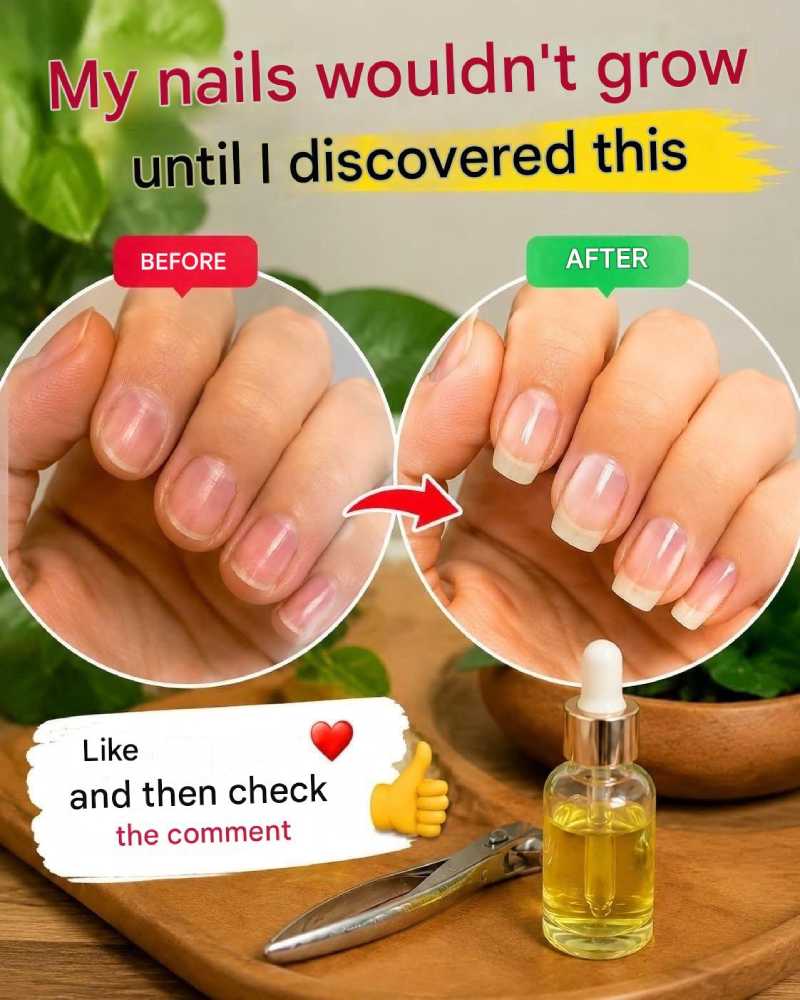
Nails that split, bend, or peel don't just appear out of nowhere. When your hand can no longer tolerate even a little bit of length, when the polish looks nice but peels off like an old crust after the first wash, the problem is usually much deeper: weakened keratin, extreme dryness, and daily habits that gradually dismantle the nail layer by layer.
And it hits harder than you think. You get ready, you go out with decent hands, and suddenly one point gets caught on the grocery bag, another splits while you're typing, another breaks while you're buttoning your blouse. By mid-afternoon you already have that feeling of "not again," as if your hands are at odds with you.
What the cosmetics industry almost never tells you is this: a pretty top coat won't save your nails if the skin underneath is still dry, damaged, and lacking essential nutrients. Your body already has the blueprint to rebuild itself; they've just taken away its fuel.
See more
about
vitamin D3.
Eat and drink.
And that's where the real problem begins: it's not a weak nail, it's a starved structure.
The internal laundry that leaves your nails in ruins. See
more
Crops and seeds
Health
Think of it this way: your nails are like the wood of an old door. If you wet it every day, scrub it with bleach, scrape it with your keys, and then leave it to dry in the sun, sooner or later it will splinter. It doesn't matter how much you paint over it; inside, it's already worn out.
The same thing happens when you wash dishes without gloves, use acetone frequently, clean with harsh chemicals, or spend all day dipping your hands in and out of water. The surface cracks, loses flexibility, and begins to flake off.
And if you also eat little protein, little iron, or are sleep-deprived, your body stops sending enough cellular energy to build a strong nail. The first thing you notice isn't a lab test: it's that the tip breaks before reaching the desired length.
See more
Vitamins and supplements
Nutrition
vitamin
The multi-billion dollar wellness industry barely whispers about it. There's no hidden patent inside something that costs 15 pesos in the market. You can't slap a brand name on a basic habit and charge 800 pesos per bottle.
That's why so many women spend money on "miracle" oils while continuing to do exactly what's breaking them down.
When the body runs out of protein, the nails are the first to show it.
Nails don't magically become hard. They're built with protein, minerals, and decent hydration; if that fails, they become thin, dull, and brittle. It's like trying to build a wall with loose bricks and watery cement: it holds for a while, but it won't withstand the impact.
See more
Nutrition
Anatomy
Health
The first thing many women notice is that their nails no longer grow evenly. Then comes the peeling in layers, as if a transparent film were flaking off, and then the annoying little pain when they catch on anything.
That's where real food comes in: eggs, beans, fish, chicken, plain yogurt, spinach, walnuts, and almonds. They're not glamorous; they're pure biological fuel to keep your body from breaking down.
And yes, iron and zinc count too. Without them, repairs become slow and clumsy, like a bricklayer working with an empty bucket.
See more
Crops and seeds
Meat and fish substitutes
Biology
Many women first notice it in the morning. You open the cupboard, grab your mug, and a fingernail bends at the slightest touch. It's not a coincidence: it's your body calling for help, a
signal that's been appearing on your hands for a while now. It's the sign that appears when stress has overwhelmed you.
Some nails don't break just because of external factors. They break because internally your repair system is working at full capacity: poor sleep, constant tension, accumulated fatigue, and worries that don't even subside when you go to bed.
See more about
vitamin D3,
eating and drinking,
and health.
⬇️For more information, please continue to the next page⬇️
